
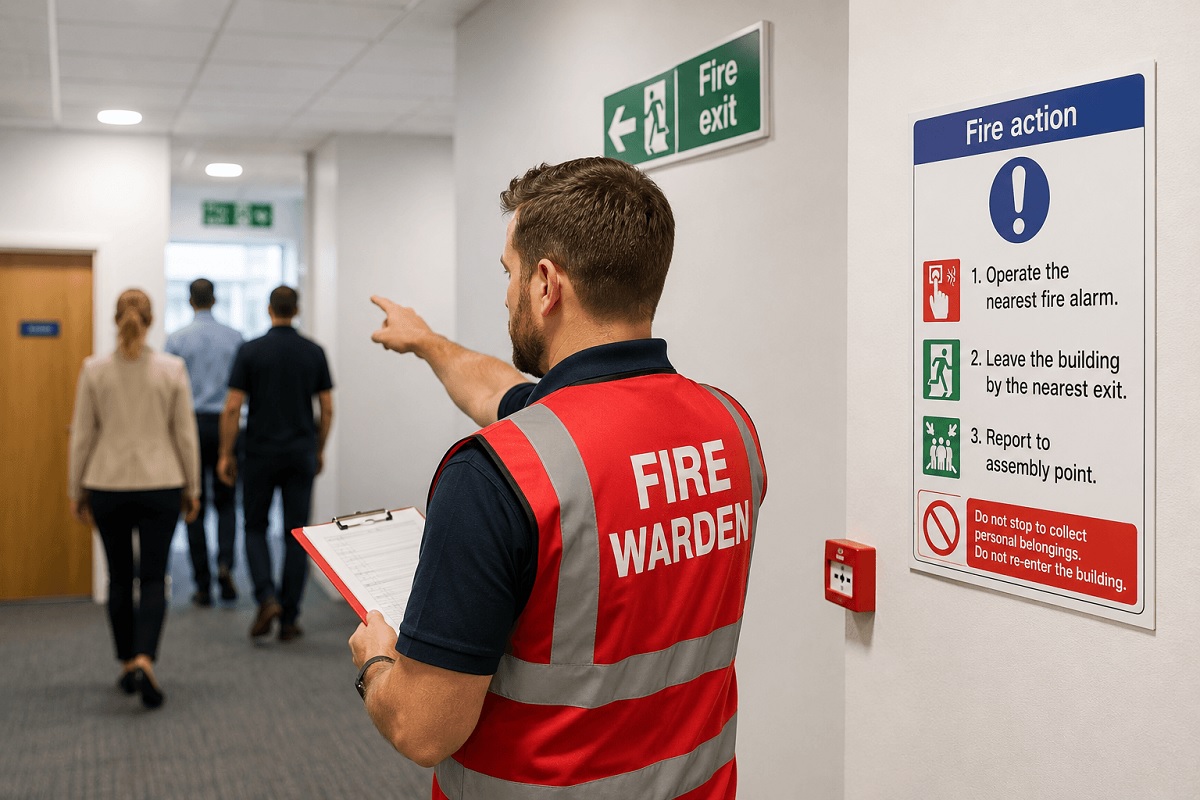
Most workplaces have a fire extinguisher on the wall and an evacuation map near the door. Far fewer have thought carefully about who will take charge if the alarm actually goes off. That is the role of a fire warden, and it is one of the most practical safety roles in any business.
Here is what fire wardens do, why they matter and how to make sure your workplace is ready.
The Role in Simple Terms
A fire warden is a staff member trained to help manage an emergency and evacuation in their area of the workplace. When an alarm sounds or an emergency is reported, wardens help make sure people leave quickly and safely, check that areas are clear and pass information to emergency services.
Fire wardens are not expected to fight large fires or put themselves at risk. Their job is to help people get out, keep things orderly and make sure nobody is left behind.
Before an Emergency
A lot of a fire warden’s value comes from what they do on a normal day. Typical responsibilities include:
- Knowing the evacuation routes, exits and assembly point for their area.
- Checking that exits and walkways are kept clear.
- Knowing where fire extinguishers, alarms and first aid kits are kept.
- Reporting hazards such as blocked exits, damaged equipment or overloaded power boards.
- Taking part in evacuation drills and helping new staff understand the procedures.
Small habits like these stop minor problems from becoming serious ones.
During an Emergency
When an emergency happens, a fire warden typically:
- Raises the alarm or responds to it.
- Directs people to the nearest safe exit.
- Checks their area, including bathrooms, meeting rooms and storage spaces.
- Helps anyone who needs assistance to evacuate.
- Makes sure doors are closed behind them where it is safe to do so.
- Reports to the chief warden or emergency services at the assembly point.
In a small business, the fire warden may also be the person who makes the first call to emergency services and meets them on arrival.
Why Small Businesses Need Fire Wardens Too
It is easy to assume fire wardens are only for large office towers or factories. In reality, every workplace needs a plan for emergencies, and someone needs to lead it. In a small team, that might be one or two trained people, but having them makes a real difference.
Without a clear leader, people can hesitate, go back for belongings or not realise others are still inside. A trained warden gives the team clear direction at a stressful moment.
What Fire Warden Training Covers
Fire warden training prepares staff to act as part of an emergency control organisation. Courses typically cover:
- Workplace emergency procedures and roles.
- How to respond to alarms and emergency signals.
- Evacuation procedures and assembly points.
- Communicating with emergency services.
- Identifying and reporting fire hazards.
In Australia, this training is commonly delivered under the national unit PUAFER005, Operate as part of an emergency control organisation.
Choosing Who Should Be a Warden
Good fire wardens are calm, reliable and usually on site. When choosing people for the role, consider:
- Staff who are regularly present rather than often out of the office.
- People from different areas or floors, so every part of the workplace is covered.
- Cover for different shifts, part-time days and leave.
It also helps to choose people others will listen to in a stressful moment.
Keeping It Simple for Busy Teams
Training does not need to take a big chunk of the working week. Some providers now offer online theory followed by a short practical session, so staff spend minimal time away from work.
On the Gold Coast, Safety Training Centre offers fire warden training Gold Coast businesses can book, delivered as PUAFER005 with online learning, a short practical session of around 30 minutes and a digital certificate issued the same day.
A Quick Checklist for Employers
- Do you have trained fire wardens for every area and shift?
- Does everyone know the evacuation routes and assembly point?
- Are exits and walkways kept clear at all times?
- Have you run an evacuation drill recently?
- Do new staff learn the emergency procedures during induction?
The Bottom Line
Fire wardens turn an evacuation plan on paper into action in real life. For a small business, training one or two people is a simple, affordable way to protect staff, customers and visitors, and to make sure everyone knows exactly what to do if the alarm ever sounds.

